
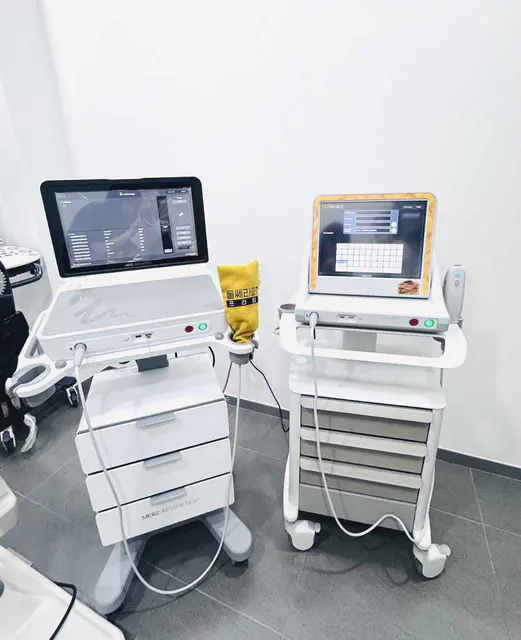
Ultherapy (often called “US-version ultrasound”) uses high-intensity focused ultrasound (HIFU) on deep tissue to lift and tighten. In recent years a second-generation device (sometimes called Ultherapy PRIME) has arrived, with growing clinical experience. This article walks through the principles, clinical differences, the treatment experience and aftercare so you can judge better during your consultation.
1. The shared foundation
Both generations use focused ultrasound (HIFU) to deliver energy to deep layers of the skin — notably the SMAS fascia — creating tiny coagulation points that stimulate collagen remodeling and contraction for a non-invasive lift and improvement of laxity and fine lines. The second generation adds upgrades to imaging guidance, transducer design, energy control and workflow that directly affect comfort and consistency.
2. Imaging guidance and targeting
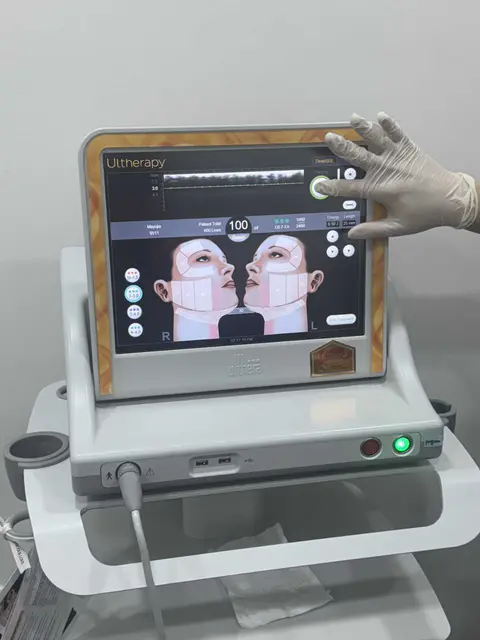
Gen 1 already had imaging so the operator could see subdermal tissue during treatment, but resolution and scan speed were limited. Gen 2 offers higher resolution and more real-time processing, so the doctor can see treatment depth and target layers (dermis, superficial SMAS) more precisely. Clearer imaging helps avoid hitting non-target tissue (vessels, dermis that is too shallow) and allows customized parameters per area — improving safety and consistency.
3. Transducers and energy output
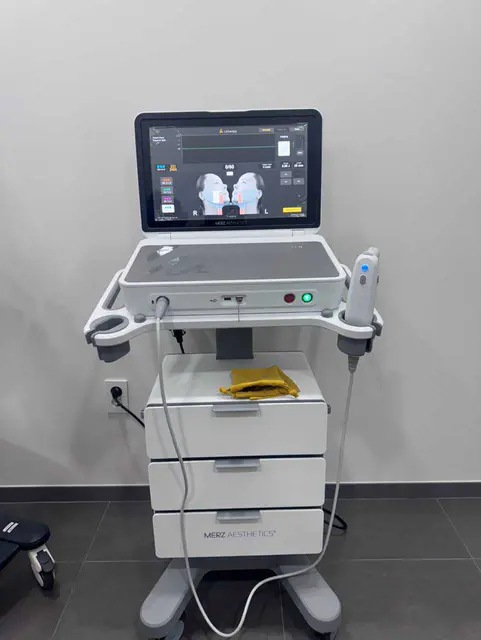
Gen 1 had a narrower transducer range and slower scanning; Gen 2 optimizes transducer design for a more stable focal point, more controllable energy per shot, and in some transducers faster continuous delivery. The result: shorter treatment time, and more stable energy distribution for the same shot count, with less risk of overheating or unevenness.
4. Pain and comfort
Gen 1 can be more painful for some patients, especially over bony prominences or near nerves. With better energy control and transducers, Gen 2 is generally less painful; local cooling or topical numbing cream further improves comfort. If pain is a concern, discuss using Gen 2, staged delivery or analgesia with your doctor in advance.
5. Treatment speed and time cost
Gen 1 is slower — a full-face session runs roughly 45–90 minutes. Gen 2’s efficiency can cut total time by about 15–30%, a practical advantage for busy patients.
6. Results and how long they last
The core biology (collagen stimulation, tissue contraction) is the same across generations; the difference is consistency and experience. Gen 2’s more precise targeting and energy usually give more consistent results. Duration depends on skin condition, age, lifestyle and aftercare — improvement typically appears over 1–3 months and lasts about 9–18 months.
7. Safety and side effects
Either generation is a high-safety, non-invasive treatment, but you may see short-term redness, mild stinging or soreness (usually settling within days); very rarely, nerve discomfort or localized overheating causing longer-term discomfort (usually linked to excessive energy or poor technique). Gen 2’s more precise imaging and energy control can, in theory, reduce mis-targeting and over-concentration of energy — but the operator’s experience remains the key safety guarantee.
8. Why do results vary so much between doctors on the same machine?
The device is only a tool. Real results depend on the doctor’s anatomical knowledge and experience (planning shot distribution, depth and energy level), individualized assessment (skin thickness, degree of sagging, treatment history), and the ability to adjust in real time. Gen 2 lowers the difficulty and pain, but a skilled doctor is still needed for the best outcome.
9. How to choose
- Want a more comfortable experience and a shorter session: Gen 2 is the better pick
- Special skin conditions or extensive treatment history: decide after an in-person assessment by an experienced doctor (regardless of generation)
- Value stable, natural lifting: the priority is a doctor with clinical experience and imaging-reading skill — a newer device is a bonus, not everything
10. Before and after care
Before: avoid recent large-area laser or thread lifts that interact with heat; tell your doctor about past surgery or skin issues. After: avoid heat (steam, sauna) for 48–72 hours; make-up is fine but avoid over-stimulation; return promptly if you have prolonged severe pain or pigment changes.
FAQ
Q: On Gen 2, does higher energy mean better results? No. Energy should be customized to your skin and tolerance; too high raises side-effect risk and does not equal better results.
Q: I had Gen 1 — do I need Gen 2? Gen 2 has advantages in comfort and targeting, but whether to re-treat or top up depends on your treatment interval and current condition, as assessed by your doctor.
Q: How soon will I see improvement? Usually over 1–3 months, with collagen rebuilding for several months; the best result is often clearest around 3 months.
Second-generation Ultherapy does bring real upgrades in imaging, transducer design and energy control, improving comfort and consistency — but a newer machine is not a cure-all. What truly decides results and safety is the doctor’s judgment and technique. At consultation, ask: which generation the device is, how parameters are customized, and how pain and even energy distribution are managed during treatment. The right machine plus an experienced doctor is what delivers an ideal, safe lift.